Kim Addonizio
One kind of writing prompt I’ve given my students is to take a quote by some artist or thinker and respond to it. I’m not sure why I was thinking about Paris in the first place, but that led me to De Beauvoir and Sartre and I started reading a bunch of their quotes online. So I had those two elements early on. As for the cat, I would have liked to write about him exclusively but I knew better than to put most of what I wrote into the poem.
Rather than a single early draft--since I can't even define what, exactly, a "draft" is, as the iterations are constantly shifting--I'd like to light down on some moments and share some early language I entertained before, fortunately, kicking it out and inviting in the final poem. So here goes, starting with the final version, so you can see what didn't make the cut.
< final version >
Existential Elegy

from Exit Opera, W.W. Norton, September 2024
< edits >
Alternate Titles
Paris
Uncertainty Principle
Existential Cat Sonnet
Situation with Philosopher & Cat
Self-Portrait with Philosophers, Pastry Chef, Laundress, & Cat
Existential Self-Portrait
Existentialists at the Deux Magots
Alternate Beginnings
My first time in Paris it was February
Remember that first time in Paris, at the train station, the croissants
piled high in a basket on the table? We thought they were free until the waiter showed up.
I never read The Second Sex
or if I did, I forgot it. But I remember my first time in Paris. It was February
Alternate Cemetery Under Snow
it was February & snowing, hours until I could check into my hotel
It was February & snowing. Great thoughts drifted down & disappeared.
it was February & snowing. I wandered through Montparnasse
as great thoughts drifted down & disappeared.
while great important thoughts drifted from the sky
& disappeared.
drifted from the clouds & disappeared. Then the clouds disappeared
& I got old.
The dead
drifted toward me & disappeared.
Alternate Cat
& about to disappear Look at you. All I can think about is the other cat.
I remember how the other cat would let me carry him around
draped over my head. This one refuses to be picked up, but nuzzles into my armpit
& purrs.
He was black,
& light shone through the tips of his ears as I held him & the Fentanyl kicked in.
Alternate Endings
A poet once said every elegy ends
in consolation, or a refusal of consolation, or an even deeper grief. Once you crushed
a ripe peach in your hand
or a refusal of consolation, or an even deeper & therefore more awful grief
said a poet once.
All I can think is
is how you once
crushed a peach in your hand
That’s where this one wants to leave you, reader, deep
down in the hole I’ve dug for us.

Rosebud Ben-Oni
In late 2021, I received a dream solicitation, one in which I did not know poets could receive. It was from a producer who asked me if I'd like to contribute some work for Paramount Networks for Jewish Heritage Month in May 2022. At that time I wasn't doing so well with my health, and I knew my words (and person) would appear on national television, on their numerous channels. And I thought, why not? You're on a book tour, after all, traveling when you're not one hundred percent anyway. They asked me for some ideas, and I gave them around 5 or 6. The one that really kicked things off was a piece I wrote called "My Judaism Is a Wild unplace." After the initial draft, which they knew would resonate with the Smithsonian Channel, my words (again, and person) would also appear to general audiences like Paramount Network itself and more the targeted audiences of MTV, Logo, Pop TV, VH1, Country Music Chanel, Comedy Central, TVLand, etc. My producer included notes like: It’s really beautiful. But also abstract. Remember that your audiences are very broad, mostly secular, mostly non-Jewish. They are not going to know words like “kaddish” “davening” and “aba.”
She was originally drawn to my poems in turn around, BRXGHT XYXS and If This Is the Age We End Discovery (the latter having just come out) especially those I'd written on string theory and science through the lens of growing up as a Jew of mixed heritage. My Mexican mother converted from Catholicism to Judaism before she married my Jewish father, who himself left a very observant family. I too was raised observant, but very much loved and deeply imbedded within the framework of my mother's family. She asked me to really open up in those multitudes, like I did in my poems, to not lose my lyricism, to tell a story that explained the line in my initial draft that she loved the most: Aba, what are we but our curiosity?
This actually compelled to rethink what life meant at the time: we were still living uncertainly in the COVID-19 era, and people, no matter from where they came, who they were, what they were doing, were more likely than not searching for something meaningful after so much loss and doubt. The curiosities that compel us forward in the worst of times and that contradictions we become in the best of them, the complexities that we must be, in order to honor and reveal that the future is and will always be there. That as a Jewish person before the pandemic, I thought I'd never find the right kind of shul in which my very wayward ideas about Judaism and Jewishness would fit into, but as my producer reminded me, it was always there, there in my writing.
Poetry is my shul, I'd utter for the first time in 2022, as a mixed Jew made up of so many things that never made a complete thing. And didn't have to. That's how the first draft became the last. And we were done. All I had to do was help you channel your curiosity, she'd said to me. Essentially what came about was work half lyrical essays and half prose poetry— and this is the one that remains my favorite because it was the way in. She and I had talks that went beyond this project, delving deep into literature, Judaism and resilience. I'm forever grateful for her and the many people who made this all happen, and that they were so kind and patient shooting me when I was so sick. They trusted me, and I trusted them, after surviving two very difficult years prior.
A friend asked later why I didn't wait until I'd recovered, when I looked and felt better; surely, they'd have understood and ask me back. I don't doubt that for one second. But I stood by my choice and said: I want to remember just where I was, when I first knew poetry was my shul, when I knew I was right where I need to be, in the wild unplace. Even in the worst of times. Especially in the worst of times. It was one of the most difficult things I've ever done, and I've had a lot of challenges. The experiences changed my life. I became a better listener for it, which is one of the best powers a writer can.
*
"My Judaism is a Wild unplace" originally appeared on Paramount Networks for the month of May 2022 in celebration of Jewish Heritage Month.
< DRAFT 1 >
my judaism is a wild unplace
My Judaism is a Wild Unplace. Border roots and Kaddish. Gives a name for what I am lacking. Makes of me a wandering portal against all that is concrete. Shakes the guts and guardrail of my convictions, painfully moves me forward through every doubt and unsolved question. It is Aba calling, Light of My Eyes, more wrong toward right, davening a new night, and my replying, Aba, what are we but our curiosity? It is the weight that would make one a planet. It is Night calling, Here I Am and everywhere, I am tested. It is strangehorse toward the riding. My faith, yes, leaves me wanting all beyond threshold, propelling me toward constant discovery. It is wilderness from which the curious awaken, over and over, and with wild, hopeful eyes, spring forward.
< final version >
my judaism is a wild unplace
My Judaism is a Wild Unplace. It is an open-air house of prayer under the palm trees of the Rio Grande Valley. It is my mixed border roots that I carry within. It has taught me how to embrace two different cultures at the same time. It is my father calling, Light of My Eyes, what is a Jewish person without practice, and my replying, what are we but our curiosity? It is my mother Esperanza calling, a better future is full of questions. It is my future calling out, What if, what if, and everywhere, I am tested. My Judaism is a testament of two worlds: a childhood of Hebrew school, and then reciting a Jewish mourning prayer for my mother’s Catholic brother. It has no limits or ending, this wild unplace from which I awaken and arise, over and over, and with curious, hopeful eyes, spring forward.

Mark Nowak
When I started to write this abecedarian sequence “LATE SUMMER & FALL …AGAIN,” I joked in an Instagram story that I was “ENTERING MY CAPSLOCK ERA” (i.e., writing in all capital letters, as MAGA does with its catchphrase MAKE AMERICA GREAT AGAIN). I employed a font that some designers claimed was closest to the MAGA font (Century Schoolbook). The first draft of this 26-page sequence, written largely during the summer of 2024, leaned heavily on the two assassination attempts of the former-future president as well as the style and tone of my previous sequences (“WINTER,” “SPRING”) in the manuscript. I hated the first rough draft, included here, because I was mimicking what I had already written rather than imagining anew.
But after the re-election of Trump in November, I decided to extensively overhaul the sequence, moving some of this text about the assassinations to “SUMMER” and totally re-writing the final sequence as “FALL…AGAIN.” In fact, I ended up tearing it down to the studs. At the time, I had been taking tons of photos in the deindustrialized Northeast where I live (rural northern New York, far western Massachusetts, and southeastern Vermont). Looking at the photos made me want to return to the photo-text tradition of my previous books, Revenants, Shut Up Shut Down, and Coal Mountain Elementary, as well as the photo-text tradition of the WPA era (particularly the photo-texts of Wright Morris who had a huge influence on my earlier books). Finally, I also decided to return to the haibun form I used in Shut Up Shut Down and make the CAPSLOCK section exclusively on U.S. hate groups from lists I had assembled and alphabetized from the Southern Poverty Law Center and other online sources. I call these grayscaled blocks “unerasures,” i.e., texts that try to bring to light (barely) the seemingly limitless names of organized American hate.
To me, the new revision tries to more thoroughly document the Anthropocene of MAGAmerica. The photographs and grayscale texts are my attempt to inscribe what Althusser called the “superstructure.” In my previous haibun sequences in Shut Up Shut Down I imagined the “poem” section of the haibun as an underlying “economic base,” but in these new poems I viewed the poems beneath the grayscaled text more as residue or trace material. The leftovers, the dumping grounds; trash heaps of shattered and sheared-away text. This “U” poem is unique in the final sequence in the book because it signals a more complete descent into “untranslatable” and/or redacted material as the book comes to an end.
< DRAFT 1 >
U

< Final version >


Juliana Spahr
I had a poem about the town formerly known as Chesire, Ohio, a town that barely exists anymore as American Electric Power bought most of the houses after residents complained about health issues from the coal burning. I was interested in the idea of ownership: why can an electrical company own the land and pollute it? I had built this poem because I was asked by Angie Sijun Lou to write something for Dark Soil, a collection of works inspired by Karen Tei Yamashita. I called that poem “38.9448013°N, -82.111255°W.” Eventually the title was changed to “The Blue Plume.”
To write this poem, I had driven to the crossroads that was once the town with a friend. We had a picnic by the river and drove around the Gavin Power plant. I took a series of notes on the plants and birds that I saw near the river that day. When I got home, I watched some video. I read some scholarly articles on coal and electricity. I googled, in short.
But the poem that I wrote was lopsided. It was more a celebration of the river than a poem about Chesire. So then I decided to rewrite the entire poem. I took out the line and section breaks. I began moving things around. Around this time the poem became about attempting to write a poem about the river. I had printed out John Ashbery’s “And Ut Pictura Poesis Is Her Name” and taped it by my desk. I began asking ChatGPT again and again to rewrite my poem as if it was by Ashbery. I took very little from the ChatGPT version but I am sure that the poem would look very different without pushing against the nonsense it generated. Then I put the poem into second person. And then had that person also use the second person. And then at some point, I just called it quits. I renamed it “Bluebird-Ghost.”
*
bio note: “38.9448013°N, -82.111255°W” was first published as “The Blue Plume” in Dark Soil: Fictions and Mythographies. Ed. Angie Sijun Lou, Coffee House Press, 2024. “Bluebird-Ghost” was recently published in Ars Poetica, Wesleyan U P, 2025.
< DRAFT 1 >
first section of “38.9448013°N, -82.111255°W”
These are these ways to hold
the river in one’s heart.
Drive south is one way to it.
Drive south and leave the flatlands behind. d
Briefly follow the Scioto
with its unusually large flood plain
spread like a skirt, along its sides.
Drive through valley bottoms smooth,
through flood deposits rich,
through a valley so wide, so deep.
Drive through farm lands
with fields full of grasses and wheats.
A place so full of a richness
that it is beyond description.
Then turn to the east,
leave the Scioto behind
and drive into the hills covered
with sugar maples, beech,
northern red oak
grown to a largeness
with the help of ferns and fungi,
a largeness that shelters
both the bobcat and the woodrat.
Slide past the churches and cemeteries
of prior generations carved into hills,
perched on the sides of the road.
Drive around and over
to arrive at this grassy lot,
at this unmarked grave of a town,
that rests beside this serpentine
turn of the river.
A path that resembles
the one taken each fall
by the warblers,
those golden-winged,
those chestnut-sided,
and those yellow-rumped.
That resembles the path of the north winds too,
the ones that the saw-whet owls
use in late November,
the main southward passage of the bobolinks too.
< final version >
excerpt from “Bluebird-Ghost”
You
add a siren off in the distance, pause
dramatically to list the names of
everyone you once kissed beneath
its bridges in the darkness that
harmonizes with fecundity. And
then you, never one to hold
back, insist on putting just one
more bird on it if only because
you want to dwell with the
words golden-winged, chestnut-
sided, and yellow-rumped. That
feeling of possibility, that you can
hold both of the river’s climates, the
subtropical one and the continental
one, in a few lines. That conviction that
all it takes is to find a few words in
the dictionary, inventory a dangerous
lexicon of allure, and allow a fleeting
encore to come out the other side.
That belief that a poem can meaningfully
insist that someone take a moment and
just bother with beauty, that someone
will understand a poem to be an
intricate sonnet of interconnected streams,
that someone will claim there
is a political beauty in a few important-
sounding words arranged in rough
syllable counts. By someone you
mean a clown, curly red hair, exaggerated
red and white lips, something funny
going on with the eyebrows, the
sort that suddenly shows up in this
locale, celebrating the intrinsic beauty
of this space with yet another poem
about lost opportunity and bad timing
in relationships. By clown you mean
yourself just moments ago. All of
that gone. You can’t say it that way
anymore. No one can. A dog is
barking as you turn your head to
see the coal barge floating down the
river’s curves, heading to the power
plant off in the near distance,
ominous beneath the blue plume of
smoke produced by its smokestacks.
Horace makes fun of those who
write of babbling brooks. And he did not
even know about coal barges and
capitalism, much less the
late capitalism that blossomed while
you sat around thinking about
the cuteness of a bobcat and a
woodrat, two enemies, sheltering
under a very large sugar maple in
an image of an impossible pax
Americana. If only for the sake
of self-analysis you think something
ought to be written about the cooling
towers, the 765-kilovolt transmission
lines, the smokestacks, the blue
plume that regularly dusts the tubal
inflorescences of the bee balm, the
stubby blue flowers of the wild
indigo, the polished, vibrant red,
deeply five-lobed racemes of the
pinnately cut and lobed wood poppy,
and the dark green and the black of
the white wood aster.
Caki Wilkinson
The first draft of “The Survival Expo” came out as a straightforward narrative, mostly just describing the scene I’d wandered into a few weeks earlier. There were a few solid lines and images, but I was struggling to find the poem’s center of gravity. Eventually, I decided to start over: using only the original first line, I rewrote the poem by hand as a single, unlineated sentence. This is one of my favorite ways to shake up a poem that lacks momentum. Instead of worrying about line breaks or language or form, I’ll just focus on keeping the sentence going. It can feel like that game where you dive all over the room to save your balloon from hitting the floor, but it usually helps me figure out what’s driving a poem and where I want it to land. That’s exactly what happened with the second draft of “The Survival Expo.” Once I understood the poem’s arc, I was able to go back and reshape the unlineated text. I did a lot of cutting (some of which became a separate poem), and I broke the text into three long sentences stretched across medium-length lines, which I thought suited the voice and sort of mimicked the action of winding through the aisles of a convention center. I also reworked the poem into a loose blank verse, which was already starting to surface at the end of the second draft. I don’t have anything high-minded to say about meter, but it’s sometimes useful for me in revision, especially with longer poems, since it makes me pay more attention to sound and rhythm. I doubt anyone would call this a musical poem, but the rhythm helps balance out the volubility—and probably says a lot about my own need to stave off chaos.
< draft >
the survival expo
It’s mostly men inside the Agricenter, pitching fallout shelters, bucket dinners, 30-minute background checks, the whole scene more than what my friend and I prepared for, my friend who says she’s finally feeling better, though all I do is compliment her hair, words I’m still eating while we make the rounds, and it’s not that I’m susceptible to a hard sell so much as lack the guts to back away or show the folks who knock on doors for God a 60-million-year-old femur, the way my ex did once (he had that sort of thing on hand, and not just bones but teeth and prints and coprolites), though this led to a protracted conversation with the religious people, who kept coming back for months, asking after him, he was never there, a stack of maglets growing by the door, the word on high no match for geologic time whose scale, I learned, can give a certain person comfort, responding to a bombing or catastrophic flood by evoking the longevity of minerals and atmospheric gasses, but I admit it doesn’t bring me comfort, one thing I bet I share with every person in the Agricenter, hawking their superbatteries and backpacks with pockets for your snares, except I still don’t have a plan for when the big one hits, not a single gallon of emergency water, so I can see why people in the Middle Ages might insist their skin was made of glass, why my cousins are devoted to their crossbows, my neighbor to her supplements and tarot, or why after dreaming I’ve been chased or choked or shot at, I like to rate myself, I swear I’m getting better at finding the trap door or saint in the subway car, and so for now, I let a shellshocked man explain the pet food he’s selling, packable and highly concentrated, was tested on cats, because dogs will eat whatever but cats are picky and, I guess, more prone to starve, it’s hard to follow really, and the only thing I end up buying is a card you can slip in your wallet in case you get held hostage and still have access to your wallet, that’s what it’s called: a hostage card—because you never know what danger you’ll walk into, like the Agricenter on a Saturday, and my friend is feeling better, done with chemo, and I don’t know what to say but can’t shut up, just keep on walking, floored and mortified, by all the ways we have to stay alive.
< final version >
the survival expo
It’s mostly men inside the Agricenter,
pricing seed vaults and metal shelters, knives
and MREs spread over dressed up tables
like alms for fraught apostles—Take, eat—
and we expected this, my friend and I,
but came in anyway, for fun, I guess,
except, to me, it feels more like a test
to prove how out of place we aren’t,
which, I’ll acknowledge, is flaw of mine,
this tendency to double down pretending
things are fine, a tactical response,
like when my friend tells me she’s feeling better
and all I do is compliment her hair,
how thick it’s growing in, how glad I am,
before I train my focus on the man
selling disaster rations meant for pets—
taste-tested, he explains, on cats, since dogs
will eat whatever but cats are picky bastards—
and see, his pack will hold a month’s supply,
and here’s a pocket for your gas mask,
and here’s a pamphlet about chemtrails too…
But it’s the truth we’re sorely unprepared
for even minor hazards, acts of god
and whatnot, living as we do along
a semi-dormant fault in Tennessee,
our billboards lit with shot theology
and ads that flash YES, SILENCERS ARE LEGAL,
so I can understand why there’s a line
for 20-minute background checks,
this being a thoroughly American
response to background checks, and fear,
compared to, say, the Middle Ages, how
King Charles VI, believing he was made
of glass, sewed iron bars into his clothes
and hardly moved, and wouldn’t let himself
be touched, so scared of shattering,
which goes to show: the kingdom of the self
will always be the hardest to defend.
I wonder what he’d think to see us probing
“superior illumination,” lamps
that burn for 40 days and charge your phone,
something my friend could use, she tells me, texting
a picture to her husband, who responds,
I think you ought to leave the Agricenter,
but then we get distracted by these cards
with punch-out tools that fit inside your wallet,
so if you’re stranded in the wilderness
or captured, and have access to your wallet,
you might save yourself. What can it hurt? we say,
and stand there for awhile comparing options—
snare locks, fishhooks, saw blade, handcuff shim—
because you never know what you’ll walk into,
and the Agricenter smells like kettle corn,
and my friend is feeling better, done with chemo,
and I don’t know what to say but can’t shut up,
just keep reloading wrong words through the last
packed aisles and turnstiles, back to Saturday,
appalled, of course, but not ungratified
by all these ways we have to stay alive.

Felicia Zamora
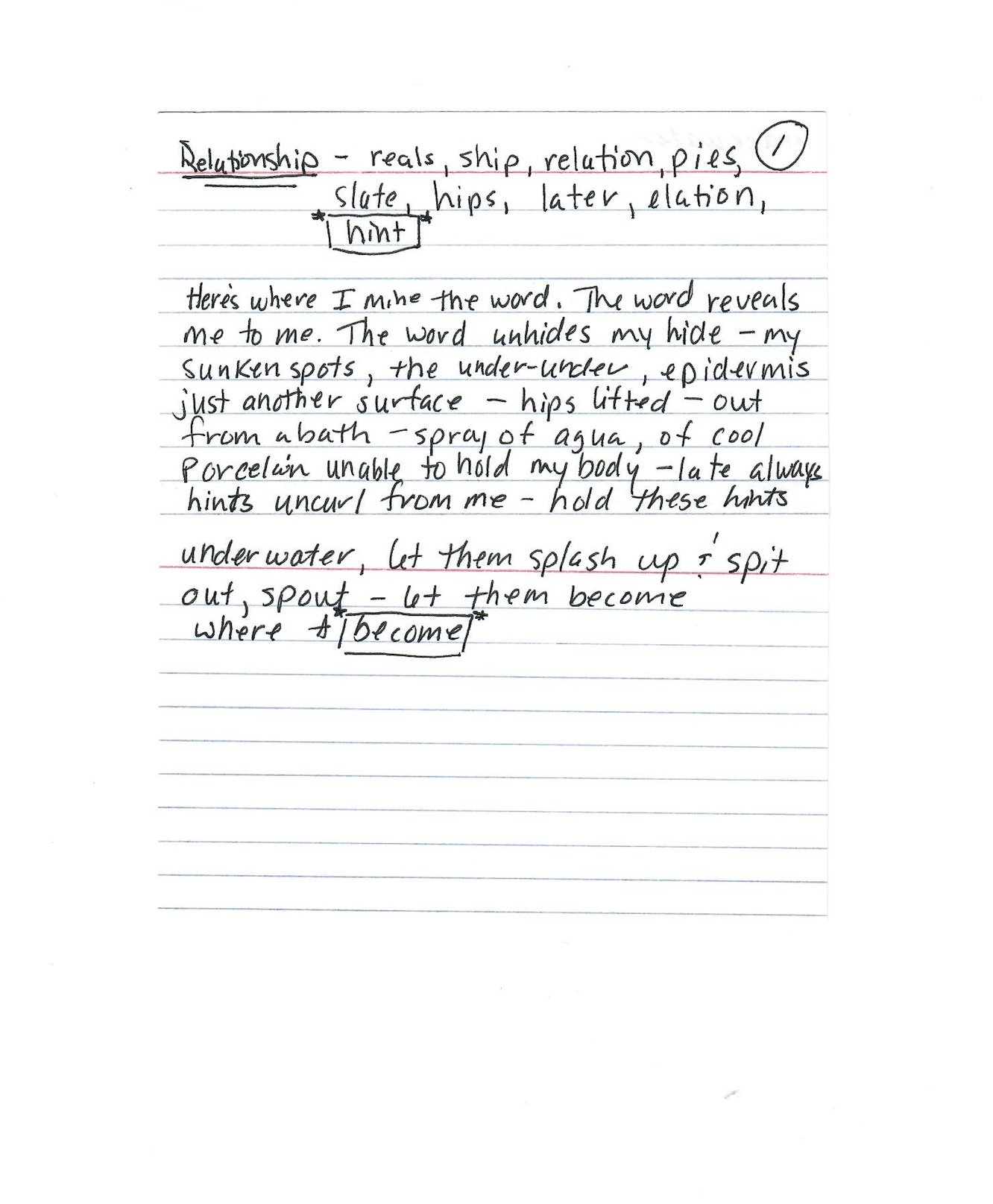
My Ph.D. poetry workshop this fall focuses on communion—who, what, when, where is communing with the artist and their poetry. I asked all artists to create Content Maps for each of the books we read this semester. (Content Map is my funny way of saying lesson plan. We intermesh artistry with pedagogy in this workshop.) The artist, Ian Fantin, created an activity from a line from Dawn Lundy Martin’s book Instructions for The Lovers. The line is “Yes, to me art is, relationships:” With Ian’s permission, I speak more on this generative prompt that meditates on Lundy’s work. Ian led the class through this activity with three steps that I’ll condense down to the meaty bits. Step one: consider the meaning, the practice, the application, of the word relationship. Step two: What relationships can you identify in your art? Step three: draft an Ars Poetica-adjacent poem. I felt compelled to write along with this activity due to Ian being gracious enough to guide us through their Content Map. I’m thrilled I did.
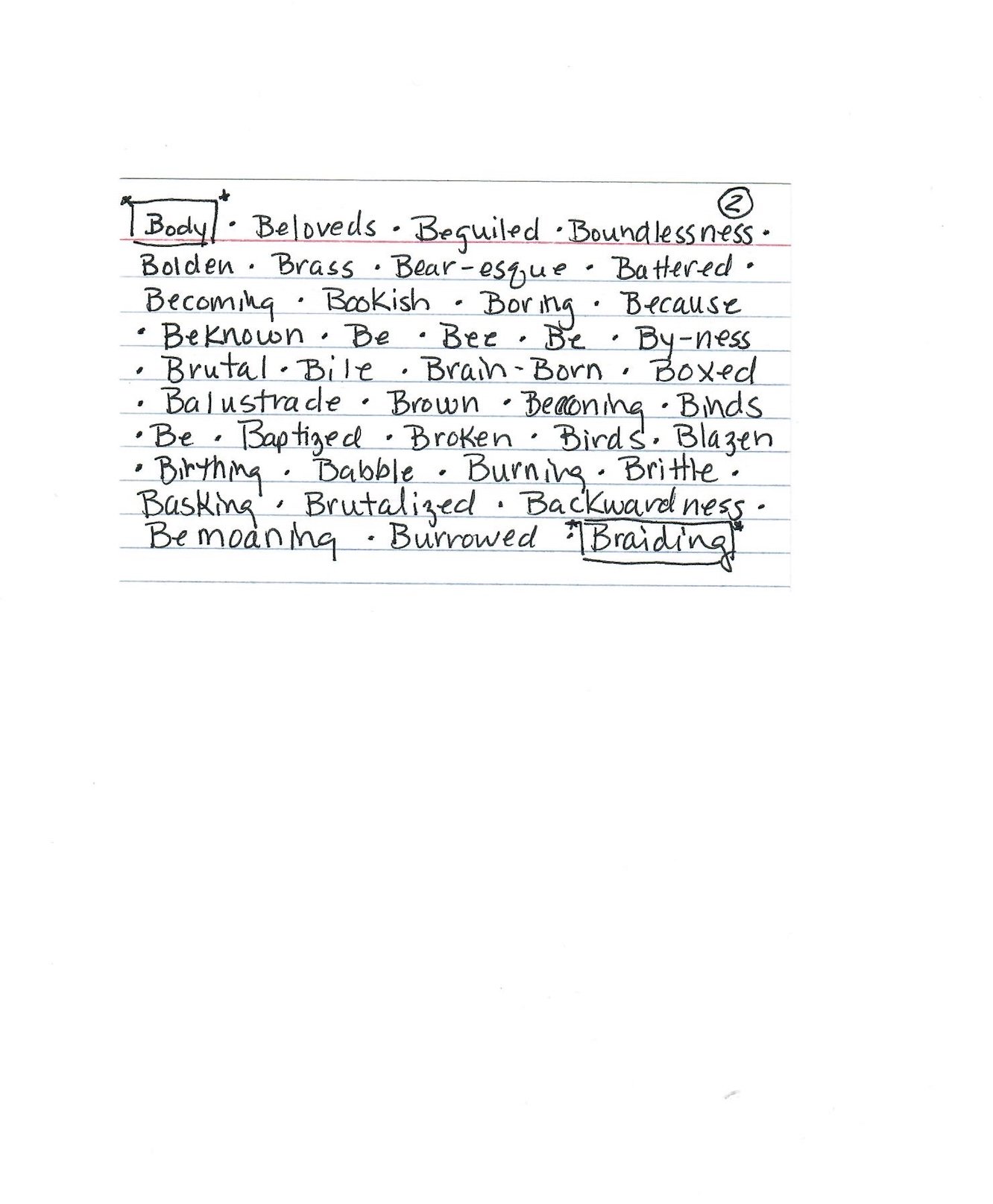
What evolved was my thinking orbiting between Lundy’s relationships and splitting open a singular word. When I attend a previous CantoMundo session led by Aracelis Girmay she asked us to mine a word. That direction sticks with me still. As poets, we are always mining shit, right—so I imagined my metaphoric shovel again. I think I needed the singularity of one word, to find the plural, to shift from educator to artist in the space. It’s hard let one’s plurality step forward authentically in the moment. The word relationship pulled me, shovel and all… as if the word was asking me to bust it open to see what my organs were really processing. And so I busted. And so I peeked into my own messy innards.